Bathroom Trends Going Out of Style in 2026 (Is Yours on the List?)
Bathrooms date faster than any other room in a house, and for a structural reason rather than an aesthetic one. Every surface in a bathroom is chosen in the same week, from the same supplier, out of the same catalogue. Tile, vanity, tapware, mirror, lighting, towel rail — one decision, one spec, one moment in time, sealed behind grout for the next fifteen years.
That is why a bathroom rarely looks slightly old. It looks precisely as old as it is. And because retiling is the most disruptive small renovation there is, most people notice the problem long before they do anything about it.
According to 2026 trend coverage from Forbes, Homes & Gardens and House Digest, the bathroom choices now reading as dated are all-grey palettes, polished chrome and fully matched fixture sets. The common thread is uniformity: rooms where every element agreed with every other element, which is exactly the quality that ages badly.
What bathroom trends are going out of style in 2026?
| Going out | Coming in |
|---|---|
| All-grey tile, vanity and floor | Warm greige, mushroom, clay, plaster and limewash |
| Polished chrome tapware | Unlacquered brass, aged bronze, brushed nickel |
| Matched fixture sets from one range | Deliberately mixed metals and unmatched pieces |
| Grey wood-look plank tile | Real stone, terracotta, warm terrazzo, timber vanity |
| Vessel sinks on flat counters | Integrated or under-mounted basins |
| Cold white LED mirrors as the only light | Warm layered light, sconces at face height |
Why do all-grey bathrooms suddenly look dated?
The grey bathroom was the most efficient design decision of the last decade. It was neutral, it hid limescale better than white, it matched every showroom display, and it removed the need to have an opinion. Which is why so many of them exist.
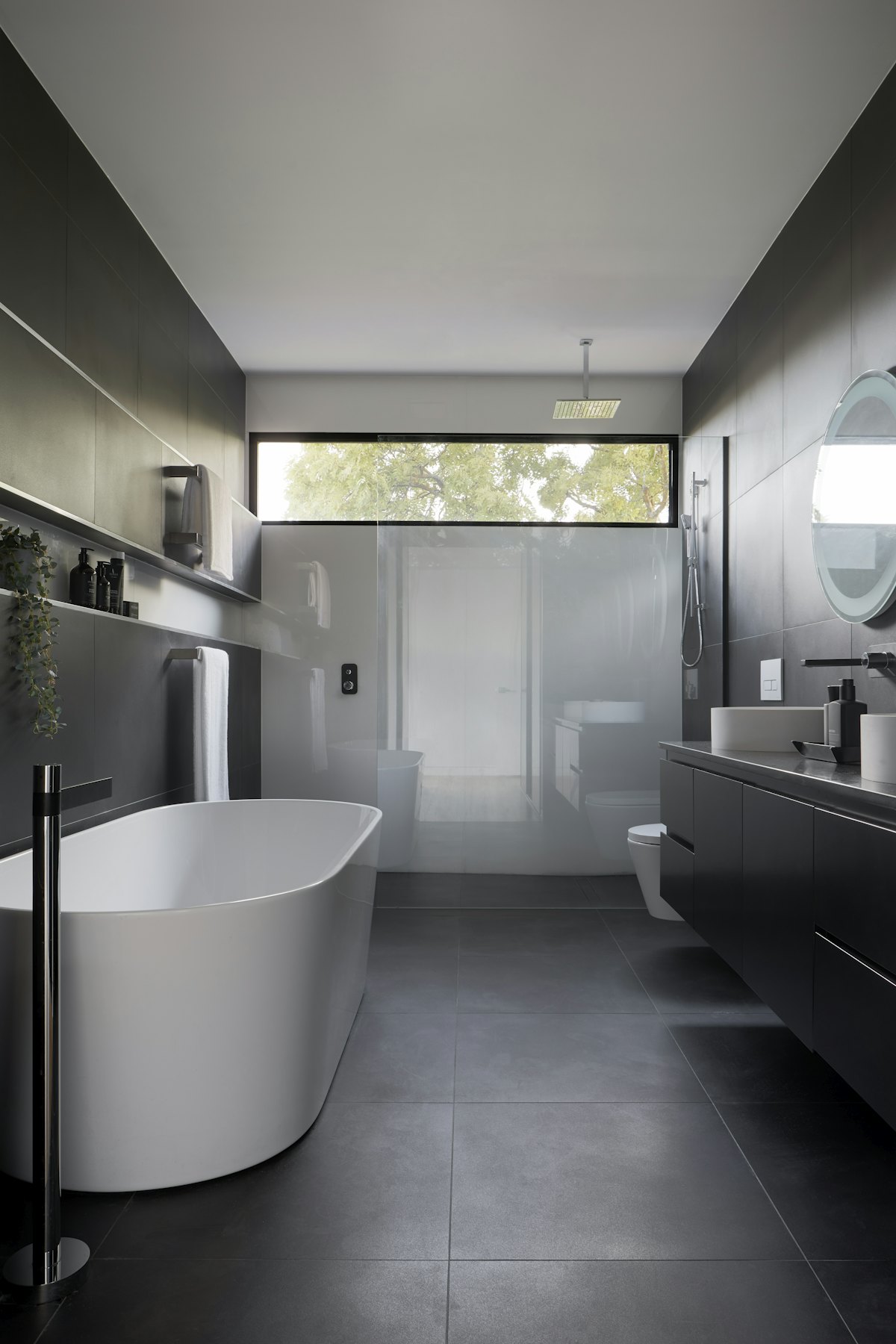
The version that dates is specific: cool, blue-based grey applied to tile, vanity, floor and grout simultaneously. One grey surface is a colour choice. Four grey surfaces stacked is a temperature, and the temperature is cold. In a room you use wet, at seven in the morning, under a single ceiling light, cold is the last thing you want.
There is a test that takes ten seconds. Hold a sheet of printer paper against the tile in daylight. If the tile reads blue or faintly lilac against true white, it is the dated version. If it reads brown or slightly green, it is warm greige and it is fine.
The replacements designers name are all in the warm neutral family — greige, mushroom, clay, stone — with plaster and limewash finishes gaining ground fastest for walls above the wet zone. Those finishes matter because they are uneven by nature. A microcement or limewash wall has variation in it, and variation is what stops a small room reading as a spec sheet.
Is polished chrome out of style in 2026?
Chrome is the finish most consistently named, and it is worth being precise about why, because chrome is not intrinsically bad.
Polished chrome reflects everything around it, including the cool grey it is usually installed next to. It has no colour of its own and therefore adds no warmth, and in a room that is already tile, glass and mirror, it is one more hard reflective surface with nothing to say. Fifteen years of builder specs defaulted to it because it is cheap, durable and inoffensive — and inoffensive at that scale becomes a period marker.
The 2026 direction is unlacquered brass, aged bronze and, for people who want quiet rather than warm, brushed nickel. Unlacquered brass is the interesting one in a bathroom specifically: it patinas where water and hands hit it, so it stops looking new almost immediately and then never looks newly dated either.
The larger shift is permission. Metals within a bathroom no longer need to match. A bronze tap with a brass mirror frame and a stainless towel rail used to look like a mistake; now it looks like a room assembled over time rather than ordered in one basket.
What is actually wrong with a matching fixture set?
This is the least intuitive item on the list and the one that does the most damage.
Builder and developer bathrooms are specified as sets — tap, shower valve, towel rail, robe hook, toilet roll holder, all from the same range in the same finish, because it is simpler to order and cheaper to buy. The result is technically coherent and reads instantly as a package. It is the bathroom equivalent of a matching bedroom furniture set: the strongest available signal that a room was purchased rather than assembled.
Breaking it costs almost nothing, because you do not have to replace everything. Change one element deliberately — a different mirror, a vintage or unmatched light, a timber stool instead of the moulded plastic one — and the whole room stops reading as a catalogue page. The set is broken by a single deliberate exception, not by starting over.
What is replacing grey wood-look tile and the vessel sink?
Grey wood-look plank tile deserves its own note because it combines two dated things at once. It is cool grey, and it is an imitation of a material that would never be used in a wet room. The 2026 alternatives go the other way — real materials with real variation: honed stone, terracotta, warm terrazzo, and timber where it can be kept out of the splash zone, usually as the vanity rather than the floor.
Vessel sinks — the bowl sitting proud on a flat counter — were the defining bathroom detail of the 2010s and have aged the way most sculptural fixtures do. They also splash, they are awkward to clean around, and they raise the tap height uncomfortably. Integrated and under-mounted basins are back, which is less a trend than a return to the version that worked.
Lighting is the sixth item and the one people forget entirely. A cold white LED mirror as the only light source in a bathroom makes every finish in the room read colder than it is, including finishes that are technically warm. Adding sconces at face height in a warm colour temperature does more for how a bathroom feels than a third of the tile budget would.
How do you preview a bathroom change before committing to tile?
Bathrooms punish imagination more than any other room, because the sample-to-surface ratio is brutal. You choose from a 10 cm tile sample and a 5 cm paint chip, and then you live with twelve square metres of the result, in a small enclosed space, under artificial light, permanently.
A warm greige that looks perfect on a sample board can go distinctly pink across a full wall under LED. A brass tap that looks rich in a showroom can look yellow against your specific tile. These are not rare outcomes; they are the normal outcome of judging large surfaces from small pieces.
The practical sequence is to see the whole room changed before anyone orders anything. Photograph the bathroom from the doorway, then apply the alternatives — warm plaster instead of grey tile, brass instead of chrome, a timber vanity in place of the white gloss one — and compare them side by side. Doing that first also answers the more useful question: which single change is doing the work? In most grey bathrooms it is not the tile at all. It is the tapware and the light.
Architectural AI exists for exactly this step. Photograph the room, run the swaps, and find out which one rescues it before a tiler is booked. The styles library covers the warm neutral and plaster directions named above, and the themed worlds push several of them into fully resolved schemes if you want to see where a direction ends up rather than where it starts.
A dated bathroom is almost never dated in six places. It is dated in two, and both of them are usually unscrewable.
FAQ
What bathroom trends are going out of style in 2026?
All-grey palettes, polished chrome fixtures, fully matched builder fixture sets, grey wood-look plank tile, vessel sinks sitting on flat counters, and cold white LED mirrors used as the only light source. Forbes, Homes & Gardens and House Digest all named grey schemes, chrome and matching sets in their 2026 coverage.
Are grey bathrooms out of style?
Cool, blue-based grey used across tile, vanity, floor and grout at once is the version that dates. It reads as a spec sheet rather than a decision. Warm greige, mushroom, clay and plaster finishes are the replacements designers name.
Is chrome out and brass in for bathrooms?
Polished chrome is the most-cited dated finish for 2026. Unlacquered brass, aged bronze and brushed nickel are the current direction, and metals no longer need to match each other within the room.
How do I update a bathroom without retiling?
Change the tapware, replace the mirror, add one warm material and fix the lighting colour temperature. Those four moves cost a fraction of a retile and address most of what makes a bathroom read as dated.
Keep reading