Is Brushed Nickel Out of Style? The Mixed-Metals Rule Designers Use in 2026
Walk through a house built or flipped between roughly 2012 and 2022 and you can usually date it from the doorknobs. Not the layout, not the paint, not even the countertop — the hardware. Every faucet, every cabinet pull, every hinge, every towel bar and every light fixture in the same satin-gray tone, because a single spec line was cheaper to order and safer to sign off.
That finish was almost always brushed nickel. It earned its decade honestly: it hides water spots, it costs less than most alternatives, it survives fingerprints, and it argues with nothing. But defaults have a shelf life, and the thing making hardware look dated in 2026 is not the metal. It is the sameness.
The short answer. Brushed nickel is not out of style — it is out of monopoly. What dates a home now is one finish repeated through every room with no variation. Designers in 2026 layer two or three metals per space, give one clear dominance, and repeat each metal at least twice. According to AOL’s home trend coverage, mixed metals is the hardware direction described as here to stay rather than a passing phase.
Is brushed nickel out of style in 2026?
No, and anyone telling you to rip it out is selling something. Brushed nickel remains one of the most practical finishes available. In a hard-water house it is still the sensible choice for a kitchen faucet, and in a family bathroom it will outlast almost anything with a lacquer on it.
The problem is what happened around it. Between roughly 2012 and 2022, brushed nickel became the finish that developers, flippers and cautious renovators reached for when they did not want to make a decision. It went on the faucet, then the cabinet pulls, then the shower trim, then the door hardware, then the pendant lights, then the curtain rods. By the time the house was finished, every piece of metal in it was the same neutral gray.
That is the tell. Not the finish — the uniformity. Uniform hardware is the visual signature of a spec sheet rather than a scheme, and it is the same instinct that produced gray walls with gray floors and gray sofas. When every decision defaults to the safest option, the safest option becomes the date stamp.
Why does single-finish hardware read as builder-grade?
Because nobody designs that way when they are actually designing.
A room assembled over time picks up variation naturally. The vintage lamp is brass. The radiator is cast iron. The kitchen taps are chrome because that is what was there. That accumulated variation is what makes a room read as lived in and considered, and it is precisely what a single-finish spec strips out.
There is also a lighting problem. Brushed nickel is a low-contrast, mid-tone gray. Repeat it across twelve fixtures in one room and none of them register — the hardware disappears into the cabinetry and the whole space flattens. Metal is one of the few materials in a room that reflects light. Using only one temperature of it means the room has one temperature of reflection.
Layering solves both. A warm metal against a cool one gives the eye somewhere to land, and it signals that someone chose.
What is the mixed metals rule designers actually use?
Not “anything goes.” There is a working formula, and it has four parts.
Two or three finishes per room. Never four. Two is safe and reads deliberate. Three is confident and needs the dominance rule below to hold together. Four metals at equal weight reads as a hardware store, not a scheme.
Give one metal clear dominance. The rough split is 60/30/10 — one finish carries most of the visible metal, a second supports it, and a third appears as a small accent, if at all. In most kitchens the dominant metal is whatever is on the plumbing and appliances, because those are the largest and least changeable pieces.
Repeat every metal at least twice. This is the rule people skip, and it is the one that makes the difference. A single brass pendant in a nickel kitchen looks like a mistake. Two brass pendants plus brass cabinet knobs looks like a decision. Repetition is what converts contrast into intent.
Keep individual fixtures pure. One faucet, one metal. Do not put a brass handle on a nickel spout. Mixing happens between objects, never within them.
What is out and what is in
| Reading as dated | Reading as current |
|---|---|
| One finish on every fixture in every room | Two or three finishes per room, layered with clear dominance |
| Brushed nickel as the automatic default | Brushed nickel chosen deliberately as the dominant metal |
| A single contrasting piece dropped in alone | Every accent metal repeated at least twice |
| Matched hardware sets bought as one bundle | Hardware chosen per surface, per function |
| High-shine chrome everywhere in the bathroom | Warm brass or bronze against a cool base, plus matte black for weight |
| Finishes matched across floors and rooms | Each room resolved on its own, with one thread carried through |
The right-hand column is not more expensive than the left. It is the same number of objects, chosen differently.
Which metals actually go together?
Warm and cool is the reliable axis. Pick a dominant metal, then pull its opposite in as the accent.
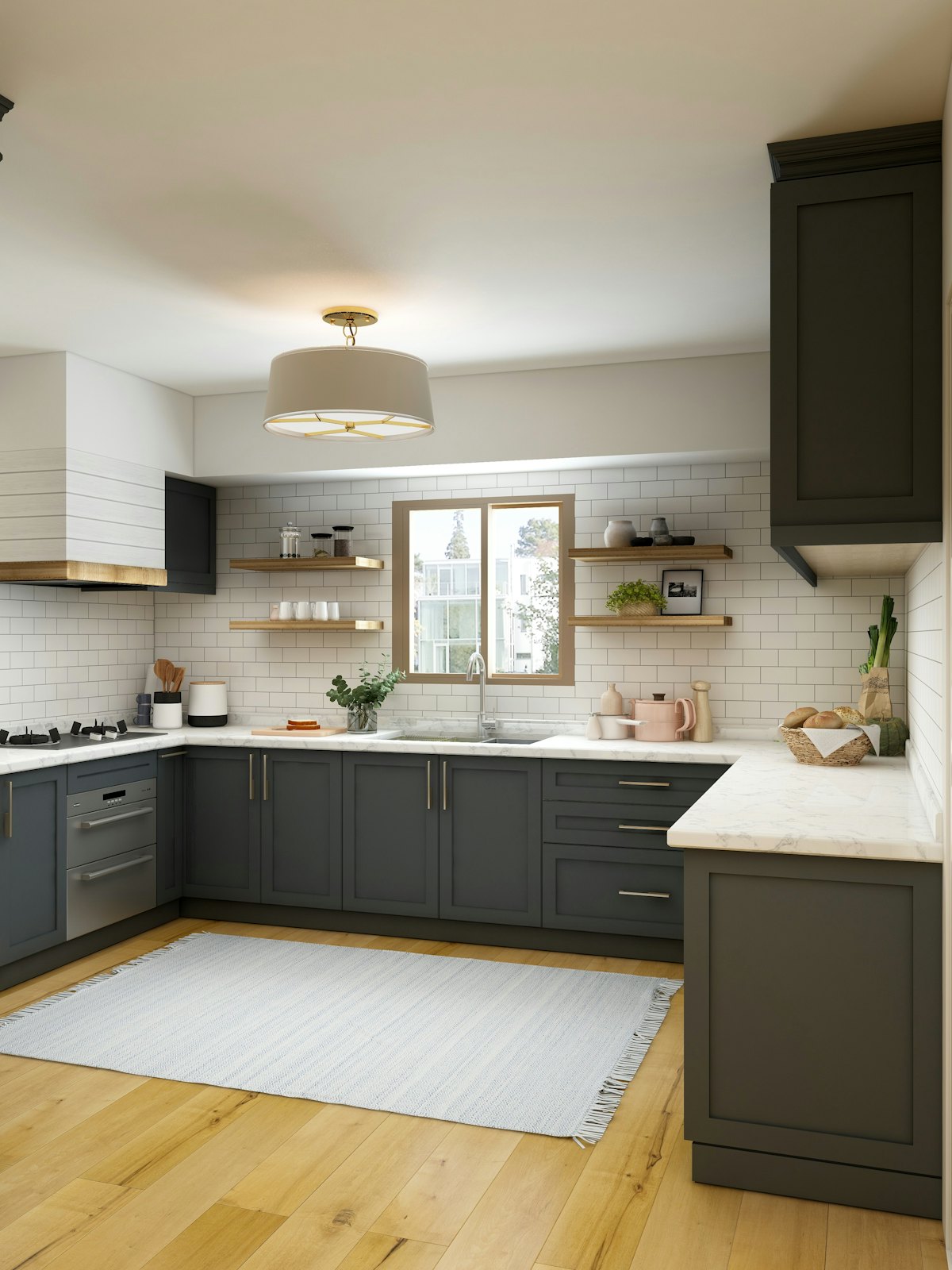
Brushed nickel plus unlacquered brass. The pairing doing the most work in 2026 kitchens. Nickel stays on the faucet and appliance handles, brass goes on cabinet hardware and pendants. Unlacquered brass patinas over time, which is either the appeal or the problem depending on how you feel about fingerprints becoming permanent.
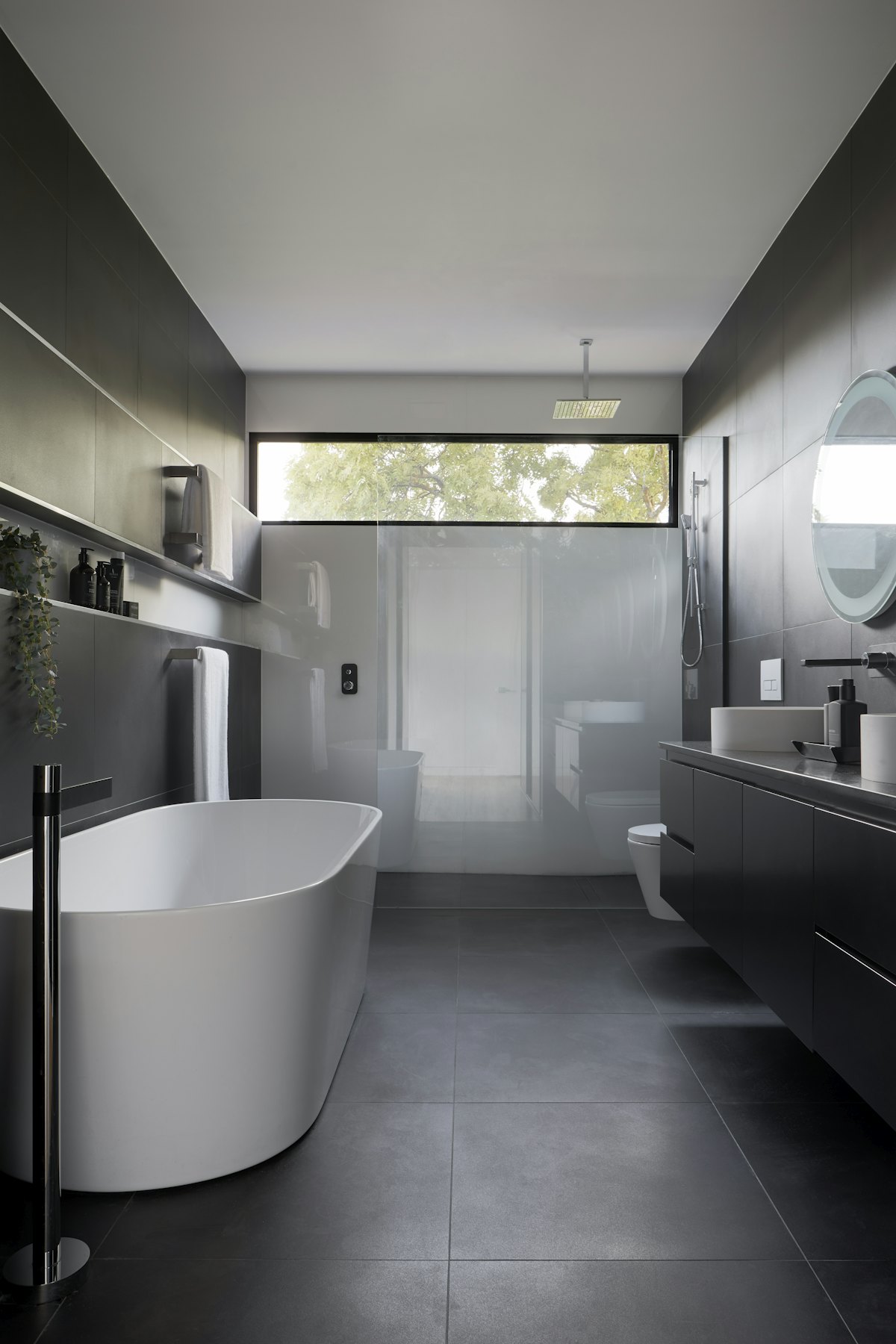
Brushed nickel plus matte black. Graphic rather than warm. Black adds weight and outline without adding temperature, which makes it the easier accent in a cool-toned or very modern room. It works especially well in bathrooms where the tile is already doing something.
Polished chrome plus aged brass. The classic bathroom pairing and the one that dates the slowest, because both finishes have been in continuous use for a century. Chrome on shower trim, brass on lighting and mirror frames.
Warm bronze or champagne bronze plus black. For rooms that lean warm already — walnut cabinetry, clay walls, terracotta tile. Bronze is softer than brass and reads less shiny, which suits a room that is already doing something with texture.
The one combination to avoid is two metals of nearly the same value. Brushed nickel next to brushed stainless next to satin chrome is not a mixed-metal scheme; it is three near-identical grays that look like a supply chain error. Contrast has to be legible from across the room or it is not contrast.
Where do you start if you only change one thing?
Cabinet hardware. Always.
Knobs and pulls are the cheapest metal in the house per visible square inch, they require no plumber, and in a kitchen they represent the largest count of individual pieces. Swapping thirty nickel pulls for aged brass changes the entire read of a kitchen for less than the cost of a single faucet, and it satisfies the repetition rule automatically because there are thirty of them.
The order of operations after that, roughly by cost and impact:
- Cabinet knobs and pulls. Highest impact per pound. Reversible in an afternoon.
- Lighting. Pendants, sconces, vanity bars. Visible from everywhere in the room and easy to make the accent metal.
- Bathroom accessories. Towel bars, rings, hooks. Cheap, and they let you test a finish before committing to plumbing.
- Plumbing fixtures. Faucets and shower trim. Expensive, disruptive, and the reason most people keep nickel as the dominant metal rather than replacing it.
- Door hardware. Last, because it spans the whole house and the count is high.
Note what is not on that list: replacing the brushed nickel. In most houses the correct move is to keep it as the 60 percent and buy a second metal for the 30.
Seeing it before you buy thirty knobs
The genuine difficulty with metals is that they are impossible to judge in isolation. A brass pull on a showroom board tells you nothing about how it will look against your particular cabinet color under your particular lighting, and a single sample knob held against a door tells you even less — because the whole point of the mixed-metals rule is repetition, and one knob cannot show you repetition.
This is the gap Architectural AI closes, and it is worth closing before the order goes in. Photograph the kitchen or bathroom as it stands, then run the same room with aged brass hardware, with matte black, with champagne bronze, keeping the nickel plumbing in place each time. What you are looking for is whether the accent metal reads across the whole room or whether it disappears — and that is a question about quantity and placement, not about the individual piece. The styles gallery covers the finish directions above applied at full room scale, which is the only scale at which a hardware decision is actually visible.
The broader point is that hardware is the cheapest lever in a renovation and the one most often left on the default setting. Nobody notices good hardware. Everybody notices twelve identical pieces of it. Have a look through what other people have done with their own rooms and the pattern is consistent: the kitchens that look designed have two metals in them, and the ones that look specified have one.
Brushed nickel was never the problem. Brushed nickel with nothing to argue with was.
FAQ
Is brushed nickel out of style in 2026?
Not as a finish. What is out is using it everywhere — every faucet, pull, hinge and light in one satin-gray tone. Brushed nickel works well in 2026 as the dominant metal in a layered scheme, paired with warm brass or matte black accents.
What is the mixed metals rule in interior design?
Pick two or three finishes per room, give one clear dominance at around 60 percent of the visible metal, and repeat every metal at least twice so it reads as intentional. Keep individual fixtures pure — never two finishes on one faucet.
Can you mix brushed nickel and brass in the same kitchen?
Yes, and it is one of the most common 2026 pairings. Keep nickel on the plumbing and appliances, put brass on cabinet hardware and pendant lights, and repeat the brass at least twice so the eye reads it as a scheme.
What hardware finish is replacing brushed nickel?
No single finish is replacing it. Unlacquered and aged brass, matte black, warm bronze and champagne bronze are all gaining, but they are gaining as partners to nickel rather than as its successor.
Keep reading